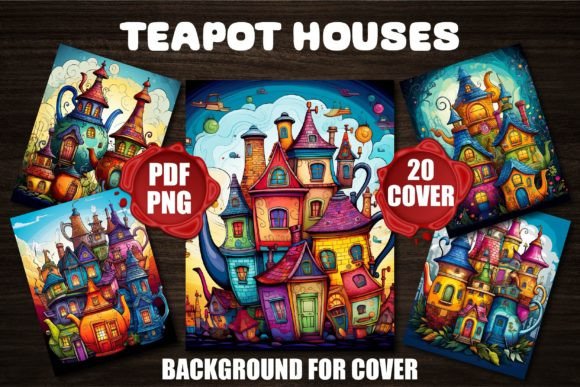
Whimsical Teapot Houses Backgrounds for Cover Art
Defining the Narrative Aesthetic of Teapot Houses
In the crowded marketplace of digital assets, finding imagery that balances whimsy with professional utility is a rare find. The Teapot Houses Backgrounds for Covers collection offers exactly that: a specialized set of 20 high-resolution designs that transform standard projects into imaginative landscapes. At its core, this set is a curated library of fantasy environments where architecture meets nature in a stylized, storybook format. The visual characteristics are defined by soft, flowing lines that mimic the organic curves of ceramic teapots integrated seamlessly with elements of flora, such as oversized mushrooms, blooming flowers, and winding vines.
The personality of these backgrounds is distinctly cozy and inviting. Unlike the sharp, cold edges of modern minimalism, this style embraces a "cottagecore" sensibility. It is a design language that speaks of comfort, warmth, and a slower pace of life. The style relies heavily on a balanced composition that guides the eye naturally, leaving intentional negative space—crucial for overlaying text on book covers or marketing materials. For designers and entrepreneurs, this isn't just a decorative element; it is a narrative tool. The AI-generated quality ensures that the intricate details—from the texture of roof shingles to the veins in a leaf—are rendered with crisp precision at 300 DPI, making them viable for both digital screens and high-quality physical prints.
Strategic Applications in Branding and Publishing
Understanding where to deploy the Teapot Houses Backgrounds for Covers is key to maximizing their value. These assets are not limited to a single niche; they function as versatile design assets across multiple sectors. For publishers on Amazon KDP, these backgrounds are an immediate solution for the "Coloring Book For Adults" market. The intricate designs serve as the perfect foundation for line art, offering the complexity required for stress relief and mindfulness activities. However, the utility extends far beyond coloring books.
- Editorial Design & Book Covers: Ideal for fantasy novels, children’s stories, or cozy mystery genres. The visual hierarchy established by the central teapot structure anchors the typography, allowing for bold title placement.
- Branding & Packaging Design: Small business owners in the artisanal sector—tea shops, bakeries, or craft stores—can use these backgrounds to create a brand identity that feels handcrafted and authentic. It elevates packaging design by adding a layer of storytelling that generic stock photos cannot provide.
- Digital Marketing & Web Design: For bloggers and content creators focusing on lifestyle, DIY, or self-care, these backgrounds make for engaging social media graphics. They stop the scroll on platforms like Instagram or Pinterest because they offer a departure from standard corporate aesthetics.
- Physical Products: Since the files are high-resolution PNGs, they are excellent for print-on-demand merchandise. Think notebook covers, planners, greeting cards, or even wall art. The versatility of the "Mega Bundle Design" approach means you have a cohesive visual system ready for multiple product lines.
Visual Hierarchy, Readability, and Audience Engagement
A common challenge in graphic design is balancing a detailed background with text legibility. The Teapot Houses Backgrounds for Covers are designed with this challenge in mind. The compositions often feature a focal point that naturally recedes at the edges, creating a vignette effect. This allows for strategic placement of typography. When pairing fonts with these backgrounds, contrast is your best ally.
Because the backgrounds are illustrative and somewhat organic, they pair best with clean, structured typefaces. A sans serif font with a modern, geometric structure can provide a pleasing contrast to the whimsical curves of the teapot houses. Alternatively, a serif font with high readability works well for titles that need to feel established and literary. Avoid overly complex script fonts or handwritten fonts for body copy, as the background details may compete with the letterforms, reducing readability.
The influence on brand perception is significant. Using these backgrounds signals to your audience that your brand values creativity, imagination, and attention to detail. It fosters an emotional connection; the imagery evokes nostalgia and comfort, which can increase audience engagement. For a small business owner, this visual consistency across platforms—using the same Teapot Houses Backgrounds for Covers on your website, your Etsy store banners, and your physical packaging—builds recognition. It tells a cohesive visual story that helps customers remember you.
Practical Workflow and Commercial Licensing
Integrating these assets into your workflow requires a practical approach to file management and design testing. The download includes 20 separate PNG files. Because they are PNGs, they come with transparent or isolated elements depending on the specific design, offering flexibility in layering.
- Evaluate the Fit: Before committing to a design for a major project, test it at a smaller scale. Does the color palette of the background complement your brand’s primary colors? If you are working on a coloring book background, ensure the line weight of the illustration matches the intended difficulty level of the activity.
- Test Font Pairings: Create mockups. Place your chosen typography over the background early in the design process. Check the kerning and leading to ensure the text breathes. A display font should dominate the hierarchy, but it must not obscure the charming details of the background that make the cover appealing.
- Review Commercial Usage: These assets are generated for commercial use, specifically designed for the Amazon KDP marketplace or other print-on-demand services. This is a critical factor for entrepreneurs. You are not just buying a picture; you are acquiring a commercial font asset that allows you to monetize your creations. Whether you are selling digital downloads or physical prints, the licensing supports your business model.
- Optimize for Print vs. Web: While 300 DPI is standard for print, loading a massive image file on a website can slow down page speed. Use image optimization tools to compress the files for web use while maintaining the quality necessary for social media graphics and digital previews.
Ultimately, the Teapot Houses Backgrounds for Covers serve as a bridge between artistic imagination and practical application. They provide the visual complexity required for art therapy and mindful coloring projects, while offering the professional polish needed for logo design and brand identity